
On May 26, the Department of Management Science and Engineering of Renmin Business School (RMBS) held a High-Level Research Paper Workshop at Mingde Business Building. The workshop featured Professor Cui Haitao from the Carlson School of Management, University of Minnesota, who serves as a Department Editor of Production and Operations Management, as the keynote speaker and paper discussant. Assistant Professor Yin Jiamin and doctoral students Lin Jiayi and Yao Junzhu presented their research. Conducted in both Chinese and English, the workshop featured in-depth discussions on artificial intelligence, platform operations, behavioral decision-making, and academic writing for top-tier journals. The event was hosted by Professor Zhu Wanshan.
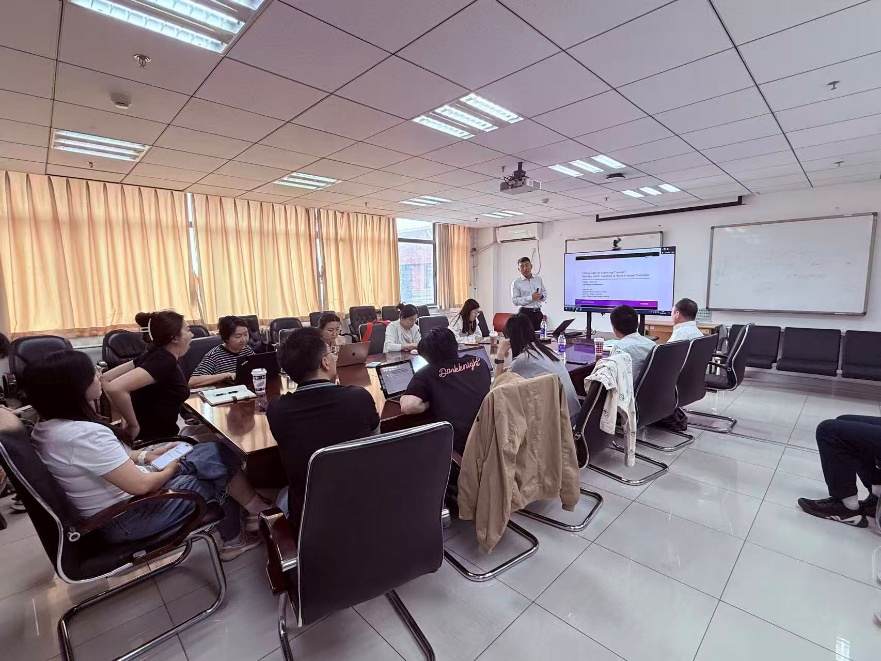
Professor Cui delivered a keynote presentation titled Filling Gaps or Replacing Creators? Strategic AIGC Adoption in Stock Content Platforms. Drawing on his editorial experience as a Department Editor of Production and Operations Management, he emphasized that amid the rapid growth of AI-related research, scholars should pay particular attention to AI’s distinctive characteristics rather than treating it simply as another technology or management tool. He encouraged researchers to formulate research questions with both theoretical and practical significance based on these unique features.
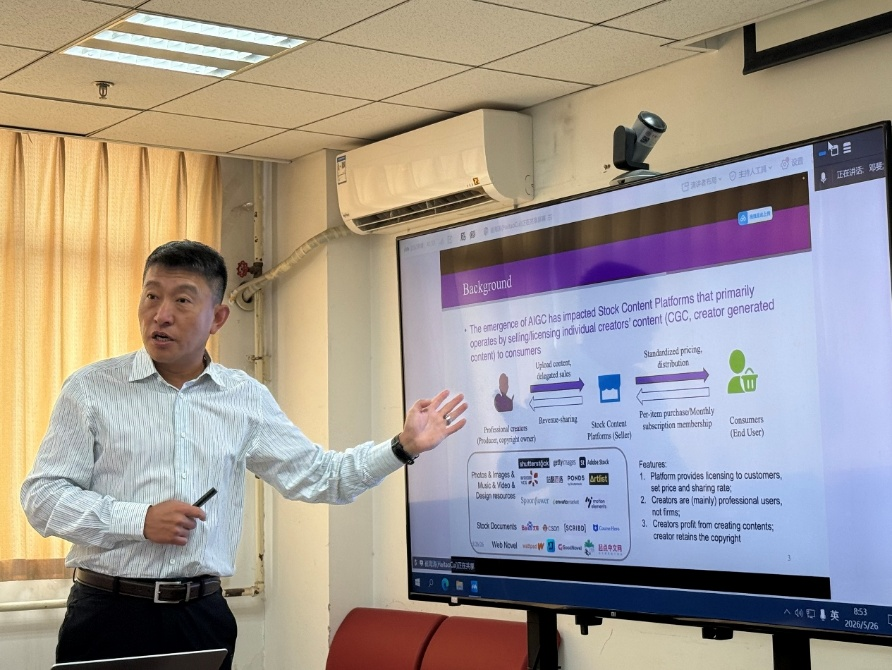
Using AIGC applications on content platforms as examples, Professor Cui demonstrated how AI’s distinctive capabilities can be transformed into meaningful research questions. His study examines how AI models can be trained on creators’ existing content to generate new works, which may in turn compete with the original creators. It further explores whether platforms should adopt AI systems trained on creators’ original content and how revenue-sharing mechanisms should be adjusted accordingly. Following the presentation, Professor Cui engaged in in-depth discussions with faculty members and students on AI research topics, platform ecosystems, creator incentives, and ways to strengthen the theoretical contributions of high-quality research papers.
Doctoral student Lin Jiayi presented her study, Behavioral Implications of Costly Information Acquisition in Newsvendor Problems: An Experimental Study, which examines how decision-makers select the accuracy of demand signals and make subsequent ordering decisions when acquiring information is costly. Professor Cui provided detailed comments on the research design and experimental methodology and suggested directions for further experiments.
Doctoral student Yao Junzhu presented Price Signaling or Blockchain Disclosure? Selling Mode and Green Information Transparency in E-Commerce Platforms. The study explores problems of information asymmetry regarding product environmental attributes on e-commerce platforms and examines how selling modes and information disclosure mechanisms jointly influence the communication of green product information. Professor Cui recognized the value of the research and offered suggestions to strengthen the paper’s theoretical framework, model development, and presentation of its underlying mechanisms.
Assistant Professor Yin Jiamin presented Do Humans Keep Thinking When AI Reasons? Cognitive Offloading in Human-AI Collaboration. The study investigates whether repeated human–AI interactions help individuals internalize logical reasoning strategies or instead lead to excessive cognitive offloading and weakened independent reasoning ability. Professor Cui also discussed how the fields of information systems and operations management can work together to advance interdisciplinary research on human–AI collaboration and generate broader academic contributions.
The workshop provided faculty members and students with a valuable opportunity to exchange ideas with an internationally renowned scholar. Professor Cui’s keynote speech and paper discussions deepened participants’ understanding of AIGC, platform operations, and behavioral decision-making. They also offered valuable guidance on identifying the distinctive mechanisms underlying AI-related research, strengthening theoretical contributions, and improving research design. Participants noted that the workshop provided a clearer understanding of how to develop research questions that are both theoretically meaningful and practically relevant by drawing on emerging management practices.