
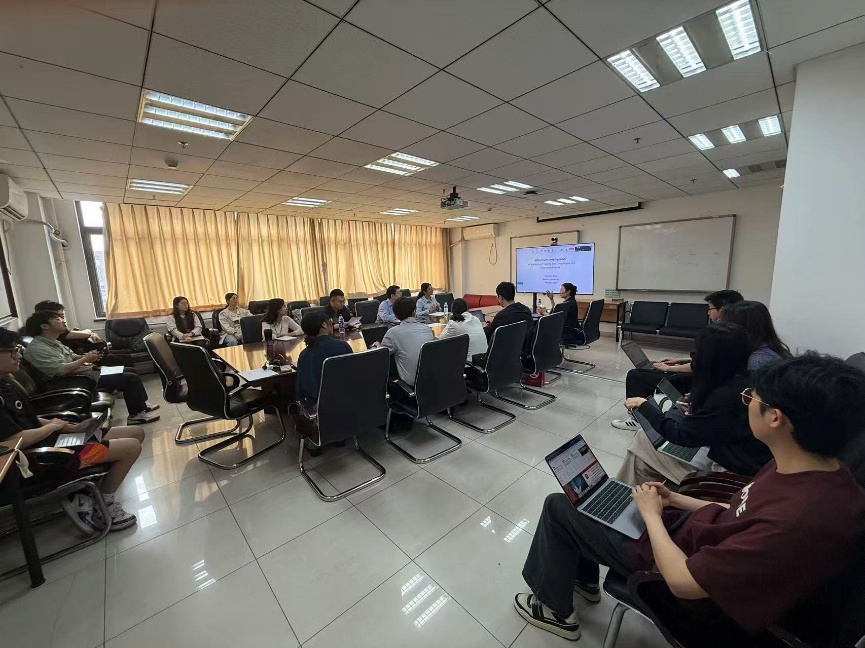
On May 19, the Department of General Management of Renmin Business School hosted a High-Level Research Paper Workshop at Mingde Business Building. The workshop featured Zhao Minyuan, Associate Professor of Washington University in St. Louis and Associate Editor of Strategic Management Journal, who delivered a keynote lecture and shared her latest research insights.
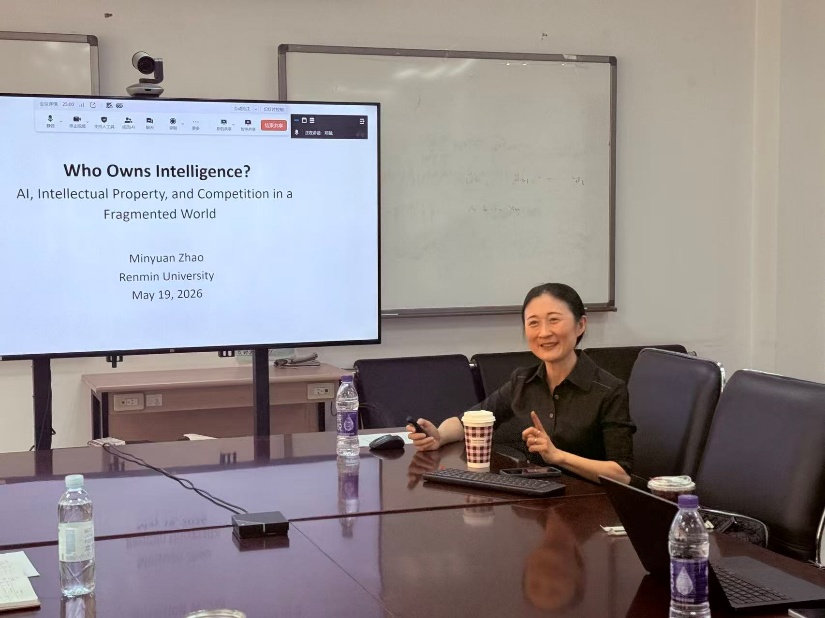
In her presentation, titled Artificial Intelligence, Intellectual Property, and Competition in a Fragmented World, Zhao drew on her extensive research in global intellectual property, multinational enterprise strategy, and innovation management to examine several pressing issues. She noted that the world is entering a new era characterized by the deep integration of artificial intelligence and increasingly fragmented intellectual property regimes. The growing tension between cross-border data flows, the global deployment of AI models, and divergent national regulatory frameworks has become a defining factor shaping competition among multinational enterprises. Referring to regulatory frameworks such as the European Union’s Artificial Intelligence Act and the General Data Protection Regulation (GDPR), as well as the evolving AI landscape across China, the United States, and Europe, Zhao analyzed their distinct development paths and emphasized that intellectual property has evolved beyond a legal protection mechanism to become a strategic asset for global competition.
Zhao also discussed key issues surrounding AI-generated content, including questions of ownership and value distribution. Drawing upon global patent litigation data and the strategic practices of multinational corporations, she argued that firms should adopt organizational strategies to bridge institutional differences while leveraging data flywheels and complementary assets to strengthen their global competitive advantages. Her presentation offered participants both rigorous theoretical insights and practical perspectives on one of the most significant issues facing businesses today.
The workshop was followed by a paper discussion session. Wang Yinghuan, a faculty member from the School of Business Administration of Capital University of Economics and Business, Ji Junkang, a faculty member of Renmin Business School, and doctoral students Jing Xiaozhou and Hu Zitai presented their working papers. Zhao engaged in one-on-one discussions with each presenter, covering topics including AI-driven innovation strategy, intellectual property management in multinational enterprises, institutional environments in emerging markets, and corporate competitiveness. She provided detailed feedback on research design, theoretical framework development, empirical methodology, and publication strategies for international journals, offering practical suggestions to help participants refine their Chinese- and English-language manuscripts and strengthen their international academic writing and research capabilities.
The workshop represents an important initiative by the Department of General Management to advance academic internationalization and strengthen research capacity among faculty and students. By bringing together the expertise of an associate editor of a leading international journal, the event created an integrated platform combining a frontier lecture with focused paper discussions. It not only highlighted cutting-edge research at the intersection of artificial intelligence and intellectual property but also addressed the practical needs of business scholarship by helping participants broaden their international academic perspectives, identify emerging research directions, and enhance their ability to produce high-quality academic publications.
Looking ahead, the Department of General Management will continue to organize high-level international academic activities that align with disciplinary frontiers and national strategic priorities. Through sustained collaboration with scholars worldwide, the department seeks to encourage faculty and students to engage with China’s development while addressing global challenges, contributing to the advancement of indigenous knowledge in business administration, and strengthening China’s voice in the international academic community.